ENG
In robes concealed, a loong lies,
Trapped within the currents of life's ties.
Soaring high, Golden Lining arise,
Fate's trials from which none can hide.
The plan he had was simple: since the old man could foresee destiny, he would surely sidestep misfortune. By staying with him, he believed he could elude all danger.
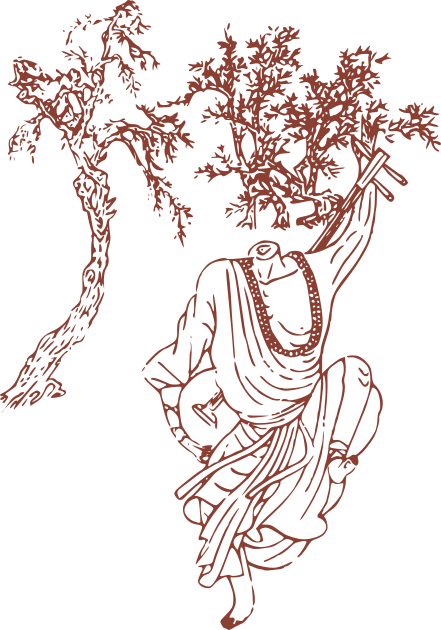
After his brothers each fled to distant realms, he transformed into a loong pattern on Yuan Shoucheng's robe.
For the next hundred years, he followed the old man across the vast lands, watching him decipher omens and foretell futures. But what good did his words change? Most, in their hubris, fell into the same snares.
Whenever this occurred, the old man would seek refuge in drink. By fortune's grace, he possessed a gourd that brewed its own wine, and thus, he often drowned his sorrows in a self-spun stupor.
In his drunken haze, the old man would often converse with the shadows. At times, he would mutter wistfully, "What use is it to see through the game if you cannot play it? And if you do not enter the game, what is the use at all?"
At other times, he would be spirited and cheerful, exclaiming, "With life and death both predetermined, so why not be bold and give it a try!"
Occasionally, he would speak with a heavy heart, "What's done shapes what's to come. How many can truly defy destiny?"
And sometimes, he would sigh and question, "If you could predict where you would die and deliberately avoid it, could you really escape?"
The loong often wondered if these words were meant for him. But since the old man never exposed or drove him away, he assumed the old man was just rambling in his drunkenness.
As time went on, these words gnawed at his heart, leaving him torn and unable to decide whether to leave.
The story begins with a loong, a dragon-like being, hiding itself inside the robes of an old seer. The loong’s plan was simple and practical: because the old man could foresee destinies, the loong believed that staying with him would let it avoid danger and misfortune. The loong sees being close to foresight as a way to sidestep bad outcomes.
The loong’s brothers did not make the same choice; each fled to distant realms. Instead of leaving, this loong transformed itself into a decorative loong pattern on the robe of the seer, whose name is Yuan Shoucheng. From that point the loong accompanied Yuan everywhere, effectively traveling with him as part of his clothing.
For a hundred years the loong watched Yuan read omens and predict futures across the lands. Yuan’s predictions, however, did not prevent people from falling into trouble. Most people, because of pride or hubris, repeated the same mistakes and fell into the same snares despite his warnings. Those failures weighed on Yuan, and he frequently sought refuge in drink.
Yuan had a magical gourd that brewed its own wine, and in his drunkenness he often talked to shadows and to himself. He repeatedly voiced different attitudes about fate: sometimes bitter, asking “What use is it to see through the game if you cannot play it? And if you do not enter the game, what is the use at all?”; sometimes bold, saying “With life and death both predetermined, so why not be bold and give it a try!”; sometimes resigned, saying “What's done shapes what's to come. How many can truly defy destiny?”; and sometimes questioning, “If you could predict where you would die and deliberately avoid it, could you really escape?”
The loong listened and wondered whether these words were directed at him, but because Yuan never exposed the loong or drove it away, the loong assumed they were just drunken ramblings. Over time the seer’s words gnawed at the loong’s heart and left it torn. The story ends with the loong still undecided—trapped in its place on the robe, struggling between staying for safety and leaving to try to control its own fate.