ENG
A beauty weds a beast so vile,
With horns and fangs, a facade's sweet guile.
In love's embrace, they form a pair,
Rolling in the haze, many lives they ensnare.
This story was told by Minister Xu.
Years ago, Xu, dissatisfied with his wife's strict adherence to propriety and her lack of warmth in the chamber, took a fiery and beautiful concubine.
This concubine had a terrible temper, often bossing Xu around and showing no respect for the lady of the house. If anyone tried to talk her into adhering to manners and propriety, she would laugh and curse them until they left in disgrace. Yet, Xu found this amusing and indulged her in every way, spoiling her with affection.
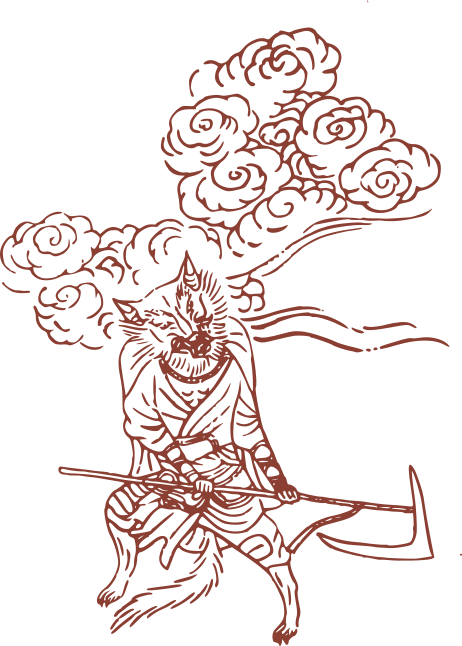
One day, Xu was returning to the capital to report on his duties. Fearing that their carriage might be attacked by bandits, he hired a large boat to transport his family, servants, and belongings back to the capital. That night, the sound of fighting suddenly erupted on the boat. It turned out that a yaoguai had sneaked aboard under the cover of darkness. Soon, a terrifying figure with horns and jagged teeth appeared. He wore a tattered cloth around his waist, held a pot-shaped shield in his left hand, and wielded an iron whip in his right, glaring menacingly at everyone.
Xu and his wife trembled in fear, but the concubine stood tall and unafraid, loudly scolding the yaoguai for his rudeness. The yaoguai was taken aback for a moment, then sighed and said, "Even in human form, you are so arrogant. Truly, you are one of us, a Yaksha."
The concubine burst into laughter and said, "Nonsense! I intended to play for a while longer, but now you've ruined everything. Fine, let's kill them all and leave together." With that, she transformed into a creature identical to the yaoguai.
Xu finally realized that he had brought a yaoguai into his home.
Just as the two yaoguais were about to kill Xu and his family, a female voice rang out, "Even though your kingdom has fallen and you were forced to seek shelter in the east, you should not behave so rudely. Why not follow me into the mountains for your practice?" Just when the two yaoguais were ready to resist, a woman descended onto the bow of the boat, holding a precious fan. With a powerful wave of the fan, she immobilized them in the wind.
After this terrifying experience, Xu never dared to take another concubine.
This is a short cautionary tale told by Minister Xu, introduced with a couplet that sums it up: a beautiful woman marries a beast in disguise, and together they trap many people. Xu uses the story to show how appearances can hide danger.
The cast is simple. Xu is a government minister who is dissatisfied with his proper, cold wife, so he takes a younger concubine who is physically beautiful but hot-tempered and wildly disrespectful toward the wife and the household rules. Xu finds the concubine’s boldness amusing and spoils her, ignoring the trouble she causes.
On the trip back to the capital, Xu hires a large boat to carry his household and luggage because he fears bandits. At night there is a sudden fight: a yaoguai — a demonlike creature — has sneaked aboard. The creature is described with horns and jagged teeth, wearing a ragged cloth, holding a pot-shaped shield and an iron whip. Xu and his wife are terrified, but the concubine openly scolds the yaoguai instead of being afraid.
The yaoguai responds by saying she is one of them, a Yaksha. She then reveals her true nature, laughs that her fun was only beginning, and transforms into a creature identical to the first yaoguai. Just as the two demons are about to kill Xu’s family, a woman appears on the boat’s bow holding a precious fan. She criticizes their rude behavior despite their exile from their kingdom, tells them to follow her into the mountains to practice, and with a powerful wave of the fan pins them down with wind.
After that night, Xu says he never took another concubine. The explicit lessons are that the concubine was actually a yaoguai in disguise, Xu’s indulgence brought danger into his home, and a more powerful woman intervened to stop the two yaoguais and summon them to the mountains. The story ends as a warning about false appearances and the consequences of ignoring propriety.